The Architecture of Presence: Contrasting Confidence and Assertiveness
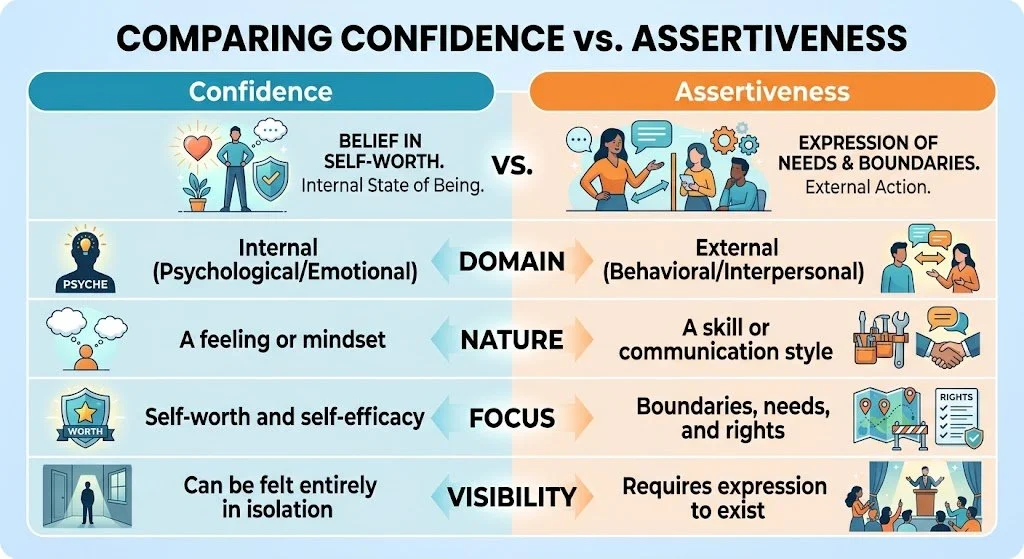
In the vocabulary of personal development, confidence and assertiveness are frequently paired, often to the point of being used interchangeably. We treat them as a singular package deal of a strong personality. However, conflating the two blurs the vital distinction between what we feel internally and how we behave externally.
Understanding the unique mechanics of both—and identifying what blocks one from becoming the other—is the key to mastering interpersonal communication and emotional resilience.
Defining the Core Differences
To contrast the two effectively, we have to look at where they live and how they manifest.
1. Confidence: The Internal Sanctuary
Confidence is an internal state of being. It is a quiet, deeply rooted belief in your own worth, capabilities, and judgment.
It answers the question: How do I view myself?
It is a psychological foundation built on self-acceptance, past successes, and the capacity to tolerate failure without letting it define your identity.
True confidence does not require an audience; it is self-contained.
2. Assertiveness: The External Bridge
Assertiveness is an external behavioral skill. It is the ability to express your needs, opinions, boundaries, and emotions clearly, directly, and respectfully.
It answers the question: How do I engage with the world?
It is a communication style that balances high respect for oneself with an equally high respect for others.
Unlike confidence, assertiveness requires an interaction. It is how you advocate for your internal worth in a social environment.
The Natural Flow: From Belief to Action
In an ideal psychological landscape, confidence acts as the fuel, and assertiveness is the vehicle. When you inherently believe your perspective has value (confidence), it should naturally follow that you speak up when your boundaries are crossed or when you have an idea to contribute (assertiveness).
However, we often see a glaring disconnect. You might meet someone who possesses immense quiet confidence in their technical skills but completely freezes, turns passive, or becomes aggressive during a meeting.
What causes this disconnect? What blocks internal confidence from translating into healthy, external assertiveness?
The Interference: Albert Ellis’s 12 Irrational Beliefs
The bridge between confidence and assertiveness is frequently sabotaged by cognitive distortions. In Rational Emotive Behavior Therapy (REBT), pioneer psychologist Dr. Albert Ellis identified 12 Irrational Beliefs—deeply ingrained, absolute "musts" and "shoulds" that distort reality and generate emotional distress.
When these irrational beliefs infiltrate your thinking, they act as an psychological dam, preventing your internal confidence from flowing into assertive action.
Here is how specific irrational beliefs interfere with that transition:
The Need for Universal Approval
Irrational Belief: "The idea that it is a dire necessity for an adult human being to be loved or approved by virtually every significant person in their community."
The Interference: You might feel confident in your ideas, but the moment you need to assert them, this belief whispers that a single frown or disagreement equals social catastrophe. Assertiveness requires standing firm even when it makes others uncomfortable. If you subconsciously demand universal approval, you will default to passivity to keep the peace.
The Fear of Making Mistakes
Irrational Belief: "The idea that one should be thoroughly competent, adequate, and achieving in all possible respects if one is to consider oneself worthwhile."
The Interference: Assertiveness involves risk—the risk of being wrong, being corrected, or executing a boundary clumsily. If you believe that your worth hinges on absolute perfection, you will withhold your voice. Your confidence remains locked away because you won't risk an assertive action that might expose a flaw.
Blame and Punishment
Irrational Belief: "The idea that certain people are bad, wicked, or villainous and that they should be severely blamed and punished for their badness."
The Interference: When your boundaries are crossed, this belief shifts your focus from stating your needs to punishing the wrongdoer. This causes confidence to warp into aggressiveness rather than assertiveness. Instead of saying, "I need you to let me finish talking," you attack: "You are an inconsiderate person who always interrupts."
Catastrophizing and Helplessness
Irrational Beliefs: "The idea that it is a terrible and catastrophic catastrophe when things are not the way one would very much like them to be," and "The idea that human unhappiness is externally caused and that people have little or no ability to control their sorrows and disturbances."
The Interference: Assertiveness is an act of agency—it assumes you have the power to influence your environment. If you believe you are a helpless victim of external circumstances and that any conflict is an unmitigated disaster, you will convince yourself that speaking up is pointless or too dangerous.
Dismantling the Barrier
To turn your internal confidence into an assertive lifestyle, you must actively audit your thinking for these absolute demands.
Catch the "Shoulds": Notice when your hesitation to speak up is driven by a rule like "I must never make anyone angry" or "They should automatically know what I need."
Challenge the Irrationality: Reframe the absolute demand into a flexible preference. Replace "I absolutely need their approval" with "I would prefer their approval, but I can handle their discomfort if I state my boundaries."
Practice Somatic Grounding: When irrational beliefs trigger a fight-or-flight response, ground your physiology. Lower your shoulders, unclench your jaw, and take a deep breath to remind your nervous system that speaking up is safe.
By dismantling the 12 irrational beliefs, you clear the wreckage off the bridge. Your internal confidence can finally walk across the threshold, expressing itself as calm, clear, and unshakeable assertiveness.

Ready to Bridge the Gap in Your Own Leadership?
Knowing the difference between confidence and assertiveness is only the first step; dismantling the deeply ingrained irrational beliefs that block your voice requires deliberate, focused practice. If you are ready to clear the cognitive wreckage, master your boundaries, and step into an unshakeable professional presence, let’s connect. Schedule a Free Confidence Booster Session today, and let’s start transforming your internal worth into impactful, real-world action.
