The Fine Line Between Focus and Panic: Performance Stress vs. Distress
We have all felt that sudden spike of adrenaline before a big moment—the dry mouth before a presentation, the racing heart before a decisive sports match, or the hyper-focus before a critical deadline.
In psychology, this surge of energy isn't necessarily a bad thing. It represents a crucial threshold where our minds and bodies prepare to meet a challenge. However, this energy can easily mutate from a powerful motivator into a paralyzing anchor. Understanding the difference between performance stress and distress—and identifying the hidden psychological trapdoor that connects them—is the key to mastering your mental game.
The Two Faces of Stress: Eustress vs. Distress
To understand performance stress, we first have to look at the Yerkes-Dodson Law, a psychological principle dating back to 1908. It dictates that performance increases with physiological or mental arousal, but only up to a point.1. Performance Stress (Eustress)
Often called "positive stress" or eustress, performance stress is the optimal amount of pressure required to keep you alert, engaged, and focused.
The Feeling: Butterflies in the stomach, heightened senses, a sense of anticipation.
The Impact: It narrows your focus, speeds up your reaction times, and pushes you to prepare thoroughly.
The Biology: Your body releases moderate amounts of adrenaline and cortisol, just enough to activate your "fight-or-flight" system without overwhelming it. You view the situation as a challenge to be met.
2. Performance Distress (Negative Stress)
Distress occurs when the pressure surpasses your perceived ability to cope. The energy that was once driving you forward suddenly turns inward, causing your performance to plummet.
The Feeling: Tunnel vision, racing thoughts, nausea, dread, or mental freezing ("choking").
The Impact: It impairs working memory, disrupts fine motor skills, and leads to procrastination or avoidance.
The Biology: The brain is flooded with stress hormones, effectively hijacking the prefrontal cortex—the area responsible for logic, decision-making, and working memory. You view the situation as a threat to your survival or self-worth.
Hitting the "Irrational Wall"
What causes a person to cross from productive eustress into destructive distress? It rarely happens because the external task suddenly got harder. Instead, it happens because they hit what psychologists refer to as the Irrational Wall—a barrier built out of cognitive distortions and faulty internal scripts.
The Irrational Wall is the exact moment your brain stops evaluating the task and starts evaluating your entire self-worth. It activates distress by shifting your mindset from objective reality to catastrophic fiction.
How the Irrational Wall Triggers Distress
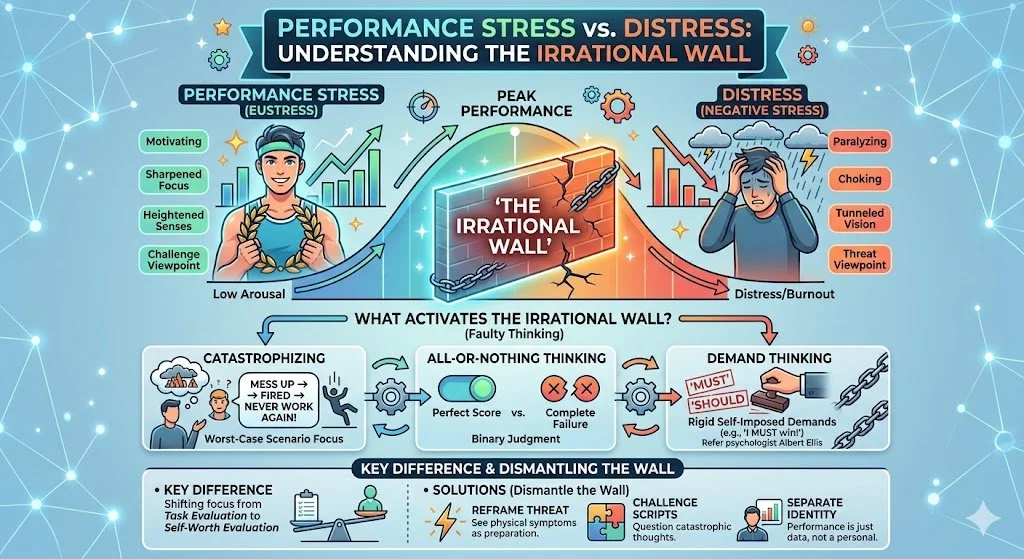
When you approach a high-stakes event, your inner monologue dictates your emotional trajectory. If that monologue hits the Irrational Wall, it fractures into three distinct patterns of irrational thinking:
1. Catastrophizing (The "Worst-Case" Magnet) Performance stress says: "If I mess up this slide, I'll have to pause and correct myself." The Irrational Wall says: "If I mess up this slide, everyone will think I’m an incompetent fraud, I’ll get fired, and I’ll never work in this industry again."
2. All-or-Nothing Thinking Performance stress says: "I want to score as many points as possible today." The Irrational Wall says: "If my performance isn't absolutely flawless, it is a complete and utter failure."
3. Demand Thinking (The "Musts" and "Shoulds") Formulated by psychologist Albert Ellis, this is the belief that you must perform well and win the approval of others, or else you are a worthless person. This rigid demand transforms a healthy desire to succeed into a desperate survival mechanism.
Once these irrational thoughts take over, the brain stops treating the presentation, game, or exam as a temporary hurdle. It treats it as an existential threat. The body responds accordingly, plunging you straight into distress.
Dismantling the Wall: How to Stay in the Zone
To keep performance stress from devolving into distress, you don't need to eliminate the stress entirely—you just need to manage the way you talk to yourself when the pressure mounts.
Pivot from "Threat" to "Challenge": Reframe your physical symptoms. Tell yourself, "My heart is racing because my body is exciting and ready to perform," rather than "My heart is racing because I am panicking."
Challenge the Irrational Script: When you catch yourself catastrophizing, forcefully interrupt the thought. Ask yourself: Is this thought strictly true? What is the actual, realistic worst-case scenario here? Can I handle it? (The answer is almost always yes).
Separate Identity from Outcome: Remind yourself that your performance on any given day is just a data point, not a verdict on who you are as a human being.
Pressure is a privilege, and performance stress is simply fuel waiting to be used. By recognizing the Irrational Wall before you run headfirst into it, you can keep that fuel working for you, rather than against you.
