The Four-Part Chronotype: The Evolutionary Wiring Behind How We Spend Our Time
Humans have spent centuries trying to conquer time. From the industrial punch card to the modern calendar app, we treat time as a commodity to be optimized. Yet, despite our best efforts to bend our schedules to our will, our brains and bodies operate on ancient, deeply ingrained biological programming.
Neurologically and evolutionarily, humans are "wired" to divide their lives into four distinct temporal buckets: Productivity, Recreation, Rest, and, surprisingly, Wasting Time. Understanding these four states isn’t just about time management—it is about understanding what it means to be human.
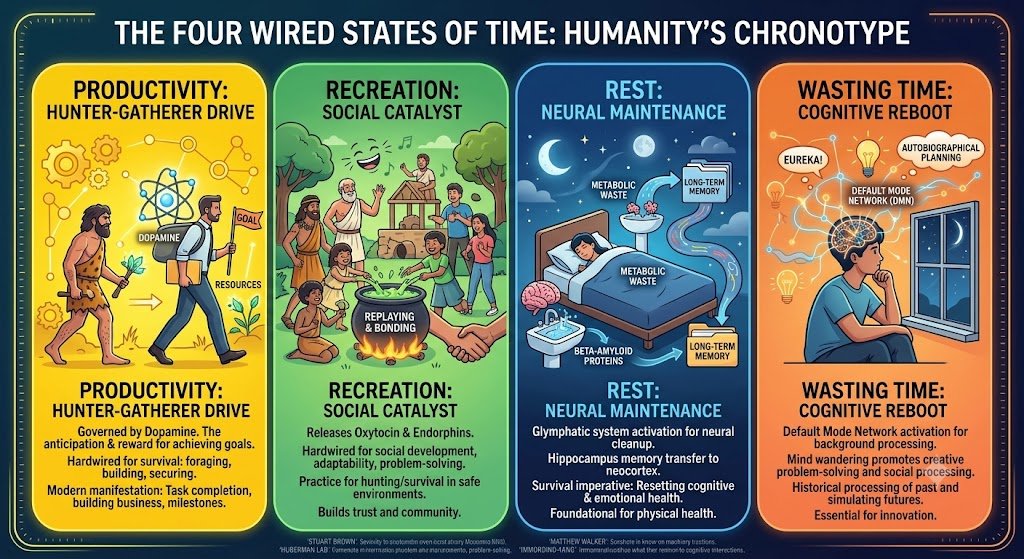
1. Productivity: The Drive of the Hunter-Gatherer
When we think of productivity, we often envision spreadsheets and corporate strategy. However, human wiring for productivity predates modern work by millennia. From an evolutionary perspective, productivity was quite literally a matter of survival: foraging, hunting, building shelter, and securing resources.
The Brain Mechanics: This state is governed heavily by dopamine, the neurotransmitter of anticipation and reward. When we set a goal and achieve it, our brain rewards us with a chemical high.
The Evolutionary Purpose: Neuroscientist Dr. Andrew Huberman notes that the dopamine system is designed to keep us moving forward, tracking milestones, and seeking out resources. Without this inherent drive to build and accomplish, early human communities would have stagnated and perished.
Today, this wiring manifests as our desire to clear an email inbox, build a business, or finish a home improvement project. It is our baseline survival instinct, repackaged for the modern world.
2. Recreation: The Social Catalyst
Recreation—play, hobbies, and social gatherings—is often viewed as a luxury. In reality, it is a biological imperative. From lion cubs wrestling in the savannah to humans playing a game of pickup basketball, recreation is hardwired into mammals.
The Brain Mechanics: Engaging in recreational activities with others releases oxytocin (the bonding hormone) and endorphins (the body's natural painkillers).
The Evolutionary Purpose: In his seminal book Play: How It Shapes the Brain, Opens the Imagination, and Invigorates the Soul, Dr. Stuart Brown argues that play is essential for social development, adaptability, and problem-solving. For early humans, "recreation" was how tribes built trust, practiced hunting skills in a safe environment, and alleviated the chronic stress of survival.
Recreation isn't just "empty fun"; it is the cognitive sandbox where our brains practice being creative and collaborative.
3. Rest: The Neural Maintenance Cycle
Of all the ways we use time, rest is the one we try most desperately to shorten—usually to our own detriment. Rest, specifically deep sleep and active downtime, is a non-negotiable biological tax that our bodies demand.
The Brain Mechanics: During deep sleep, the brain’s glymphatic system acts like a microscopic dishwasher, clearing out metabolic waste products (like beta-amyloid proteins) that accumulate during our waking hours. Furthermore, sleep is when the hippocampus transfers short-term memories into the neocortex for long-term storage.
The Evolutionary Purpose: As sleep expert Dr. Matthew Walker famously writes in Why We Sleep, "Sleep is the single most effective thing we can do to reset our brain and body health each day." For our ancestors, vulnerable as they were to predators while sleeping, the fact that sleep survived natural selection proves its absolute necessity.
Without dedicated time for rest, our cognitive faculties degrade, our emotional regulation fractures, and our physical health collapses.
4. Wasting Time: The Essential Cognitive Reboot
There is a profound difference between intentional rest (like sleep or meditation) and what we colloquially call "wasting time"—staring out a window, daydreaming, or mindlessly pacing. While society condemns this as laziness, cognitive science reveals that the brain is fiercely active during these moments.
The Brain Mechanics: When we cease focusing on a specific task and let our minds wander, a network in the brain called the Default Mode Network (DMN) lights up.
The Evolutionary Purpose: Research published in Perspectives on Psychological Science demonstrates that the DMN is crucial for "autobiographical planning," creative problem-solving, and processing complex social dynamics. When we are actively working, our focus is narrow. When we "waste time," our focus widens, allowing the brain to connect disparate ideas and come up with "eureka" moments.
Historically, letting the mind drift allowed humans to process past experiences and simulate future scenarios. "Wasting time" is actually the brain’s way of performing background defragmentation.
Finding the Balance
Modern culture often tries to force humans into a binary existence: you are either being productive, or you are resting so you can return to being productive.
True cognitive and emotional well-being requires acknowledging that we are wired for all four states. Denying our need for play or guiltless daydreaming doesn't make us more efficient; it simply burns out the delicate machinery of the human mind. By respecting our evolutionary wiring, we can stop fighting time and start living in harmony with it.
Ready to realign your schedule with your biological blueprint? If you are tired of fighting your natural wiring and want to optimize how you navigate productivity, recreation, rest, and white space, let’s map it out together. Head over to ascentls.com/freeconsultation to schedule your free session, where we will review your current time attitudes, identify where your energy is leaking, and build a sustainable, human-led approach to your daily routine.
References & Further Reading
Brown, S. (2009). Play: How It Shapes the Brain, Opens the Imagination, and Invigorates the Soul. Avery.
Immordino-Yang, M. H., Christodoulou, J. A., & Singh, V. (2012). Rest Is Not Idleness: Implications of the Brain's Default Mode Network for Human Development and Education. Perspectives on Psychological Science, 7(4), 352–364.
Huberman, A. (Host). (2021). How to Focus and Maximize Your Dopamine [Audio podcast episode]. The Huberman Lab Podcast.
Walker, M. (2017). Why We Sleep: Unlocking the Power of Sleep and Dreams. Scribner.
