Processing Emotions Through Positive Inquiry: A Strategic Roadmap
When navigating dense workloads, personal transitions, or daily pressures, emotions are often treated as obstacles to be bypassed. However, suppressing or ignoring these internal signals acts as an energy leak, eventually leading to cognitive fatigue and physical depletion.
Positive Inquiry reframes emotional processing. Instead of viewing uncomfortable emotions as failures or disruptions, Positive Inquiry treats them as valuable, data-rich indicators. Grounded in applied psychology and somatic awareness, this methodology uses constructive, open-ended questioning to decode what your emotions are trying to tell you, allowing you to move from a reactive state to an adaptive one.
Here is the strategic breakdown of who, what, when, where, and how to implement this framework.
The 4 Ws (and an H) of Positive Inquiry
Who is this for?
This approach is for any individual looking to move beyond surface-level self-care and build genuine psychological resilience. It is particularly impactful for professionals, solopreneurs, and leaders navigating high-stakes environments where decision-making clarity is critical and emotional reactivity carries a high business or personal risk.
What is it?
Positive Inquiry is a structured, appreciative self-coaching framework. Unlike traditional venting—which can spiral into rumination—Positive Inquiry focuses on discovering the functional utility of an emotion. It treats emotions as a form of feedback, asking: "What is this feeling protecting, highlighting, or requesting?"
When should you use it?
Proactively: During a planned "strategic pause" or a mental health check-in to audit your current psychological state.
Reactively: The moment you notice a sudden drop in energy, a spike in anxiety, or a physical stress response (e.g., a clenched jaw or shallow breathing).
Where should you practice it?
Ideally, in a space free from immediate digital distractions. However, because it is an internal cognitive framework, it can be deployed anywhere—at your desk between high-stakes calls, during a weekend grounding routine, or while winding down in the evening.
How does it work?
By shifting the brain out of a defensive "fight-or-flight" loop and engaging the prefrontal cortex through deliberate, curious questioning.
The Triad of Emotional Awareness
To effectively query an emotion, you must first capture it across three primary domains: the physical body, the mind, and resulting actions.
1. Physiological Signs (Somatic)
The body registers threat or alignment long before the conscious mind labels it. Look for localized tension (shoulders, jaw, chest), changes in breathing depth, gastrointestinal shifts, or sudden temperature variations.
2. Mental Processes (Cognitive)
Emotions trigger distinct cognitive patterns. Notice cycles of workplace overthinking, perfectionism, catastrophic forecasting, internal criticism, or an inability to focus on a single task.
3. Prompted Behaviors (Action)
Identify the immediate behavioral urges driven by the emotion. This includes defensive posturing, sudden social withdrawal, compulsive checking of notifications, procrastinating on key projects, or overworking to outrun anxiety.
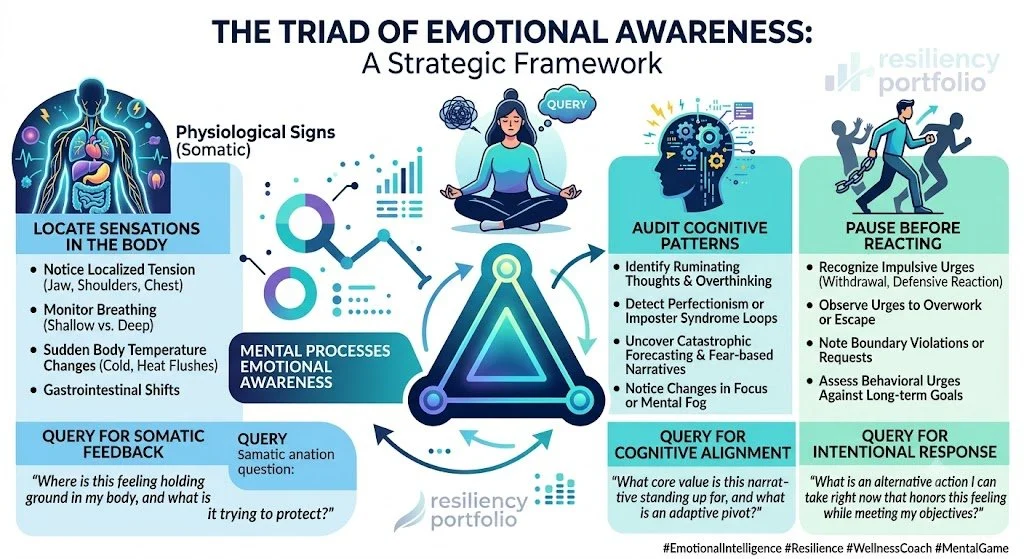
Practices for Querying Your Emotions
When an intense or uncomfortable emotion arises, avoid asking "Why am I feeling this way?" (which often leads to self-blame or circular logic). Instead, deploy these Positive Inquiry Practices:
1. The Somatic Scan & Welcome
Locate the physiological sensation. Sit with it without trying to fix it or force relaxation.
The Query: "Where is this tension holding ground in my body right now? If this physical sensation had a job description, what would it be trying to protect me from?"
2. Identifying the Hidden Need
Every challenging emotion points directly to a core value or an unmet need. For example, boundary anxiety often highlights a deep need for personal stability and rest.
The Query: "What core value is this emotion standing up for? What resource, boundary, or supportive connection is my system explicitly requesting right now?"
3. The Adaptive Cognitive Pivot
Evaluate the mental loops triggered by the emotion and gently challenge their absolute truth using cognitive flexibility.
The Query: "What narrative is this emotion whispering in my ear? While acknowledging this perspective is valid, what is an alternative, more adaptive interpretation that serves my long-term well-being?"
4. Intentional Behavioral Alignment
Before letting an emotional urge dictate your next action, introduce a conscious pause to choose an intentional response.
The Query: "The urge is telling me to push through/withdraw/react. What is an alternative action I can take right now that honors this feeling while keeping me anchored in my goals?"
The Resiliency Mindset
True, real-world resilience isn't about maintaining a flawless state of calm; it’s about expanding your capacity to absorb life's bumps. By replacing judgment with curiosity, Positive Inquiry turns your emotional climate into a customized roadmap for long-term health, clarity, and performance.
Discover Your Strategic Framework. Visit www.ascentls.com/freeconsultation and schedule your free discovery session today!
