Cultivating the Fluid Mind: The Power of Adaptive Attitudes
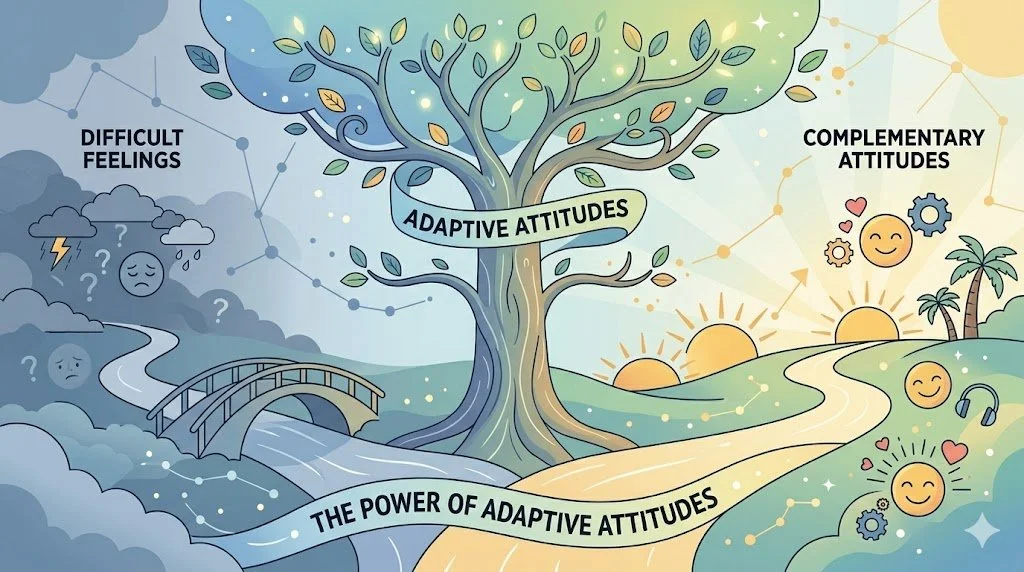
Life rarely follows a perfect script. We encounter unexpected detours, sudden setbacks, and daily stressors that threaten to throw us off balance. In these moments, the secret to resilience isn’t trying to force an unyielding, unbreakable mindset; it’s developing an adaptive attitude.
An adaptive attitude is the psychological equivalent of a shock absorber. It doesn’t prevent the bumps in the road, but it dramatically changes how you experience them, allowing you to navigate change and stress with grace and agility.
What is an Adaptive Attitude?
An adaptive attitude is a flexible perspective that allows you to assess a situation realistically, accept what you cannot control, and actively adjust your focus toward what you can influence.
Unlike toxic positivity—which demands that you ignore pain and put on a fake smile—an adaptive attitude acknowledges the reality of difficult emotions. It is deeply rooted in principles like The Serenity Prayer: having the courage to change what you can, the serenity to accept what you cannot, and the wisdom to know the difference.
The Art of "Dialectical Complementing"
One of the most effective ways to build an adaptive perspective is to learn how to complement a negative feeling with a positive or constructive one. In psychology, we often recognize that two seemingly contradictory things can be true at the same time. You don't need to completely eradicate a negative emotion to feel better; instead, you can hold it in one hand while introducing a helpful, supportive attitude in the other. By pairing a difficult emotion with a complementary positive one, you dilute the intensity of the stress and create space for coping.
The Difficult Feeling / Attitude The Complementary Adaptive Attitude The Coping Outcome
Anxiety & Fear
(e.g., "I'm terrified of failing this presentation.")
Curiosity & Preparation
(e.g., "I wonder what part of this topic I can share that will genuinely help someone?")
Shifts energy from passive dread to active, focused engagement.
Frustration & Anger
(e.g., "This traffic is ruining my entire day.")
Acceptance & Gratitude
(e.g., "I can't control the cars, but I can use this time to listen to a favorite podcast.")
Lowers physiological stress and reclaims personal agency.
Overwhelm & Despair
(e.g., "There is too much to do, I'll never get through this.")
Self-Compassion & Micro-Focus
(e.g., "I am carrying a lot right now. I just need to do the very next small step.")
Calms the nervous system and breaks paralysis.
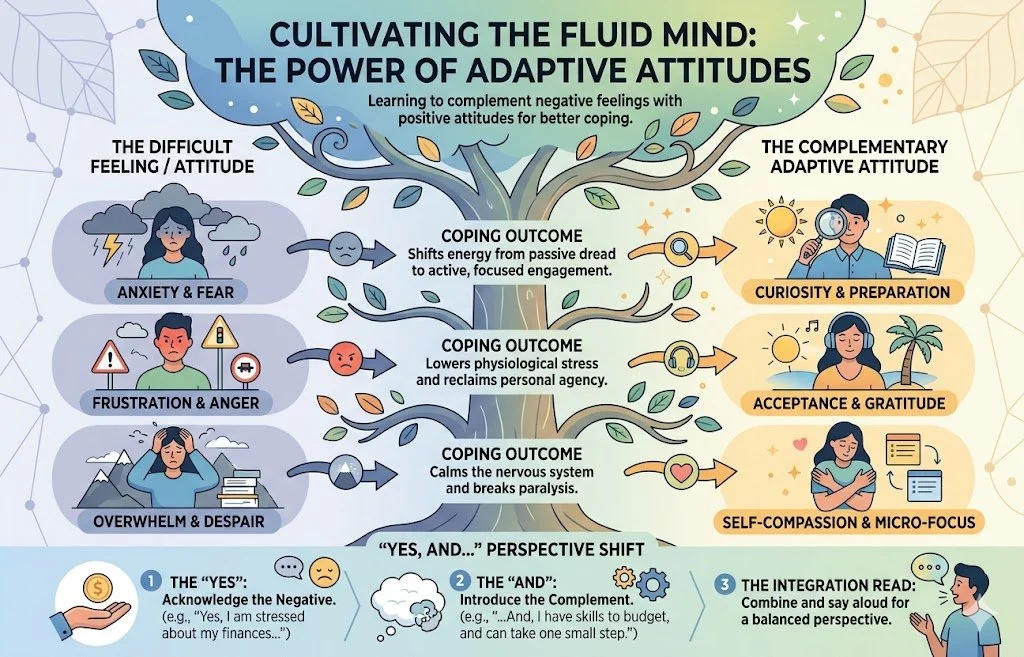
Exercise: The "Yes, And..." Perspective Shift
To help you practice this in your daily life, try this simple three-step written exercise. It uses a core rule of improvisational comedy—"Yes, and..."—to train your brain to acknowledge a negative reality while instantly pivoting to a complementary, adaptive focus.
Step 1: The "Yes" (Acknowledge the Negative)
Identify a current stressor or negative attitude you are gripping tightly. Write it down honestly, beginning with the word "Yes..."
Example: "Yes, I am incredibly stressed about my finances right now, and it makes me feel insecure."
Step 2: The "And" (Introduce the Complement)
Without erasing what you just wrote, add the word "And..." followed by a complementary positive reality, action, or attitude. This could be a statement of gratitude, a reminder of your resilience, or a small area of control.
Example: "...And, I have the skills to budget, I have a roof over my head tonight, and I can take one concrete action today by reviewing my subscriptions."
Step 3: The Integration Read
Read the entire sentence out loud. Notice how the negative feeling doesn't completely vanish, but its power is muted because it is no longer the only thing in the room. You have successfully created an adaptive frame.
Moving Forward with Flexibility
Creating an adaptive attitude is a daily practice, not a one-time destination. The next time you feel a heavy, negative attitude taking over, don't fight it or berate yourself for having it. Simply pause, pull out your mental toolkit, and ask: "What positive, adaptive attitude can I invite into this space to complement this feeling?" By allowing your mindset to blend acceptance with action, you’ll find that you don't just survive life's transitions—you adapt and thrive through them.
Unlock your mind's true potential and build the psychological shock absorbers you need to thrive through any setback.
Ready to move beyond basic stress management and master the art of adaptive attitudes? Dive deeper into the science of resilience with the official Positivity and Relaxation Training (PART) Program at Ascent Lifestyle Solutions.
👉 Explore PART Training on ascentls.com and start cultivating your fluid mind today.
